
"Cult of the Infinitely Baffled"
IB Subwoofer (aka IB subs)- FAQ Pages
Generic 'how-to' guide for designing, building,
installing, and fine-tuning your IB subwoofer
Page 4
An Introductory Guide to Subwoofers
Advanced (but inexpensive) Test Equipment & Software
______________________________________________________________________________________________________________________________
The test equipment discussed here requires the use of a PC that contains a duplex soundcard. If your PC (or laptop) doesn't have a duplex soundcard, you can purchase a relatively inexpensive external USB unit for this purpose. Note that some external sound cards have built-in mic preamps and phantom power. If you buy one of those devices, you don't need the a mic pre-amp.
The hardware shown here is adequate for measuring and designing loudspeakers. The software discussed here is for in-room testing (optimizing placement, using EQ, placing bass traps, etc.), it's not sophisticated enough for scratch building loudspeakers.
________________________________________________________________________________________________________________________________
Integrated Component
(USB soundcard/mic pre-amp/phantom power supply)
If you want a very compact easy to use all in one unit, the M-Audio MobilePre USB is a good choice. It's a full duplex USB external soundcard, that contains a mic preamp with +48V phantom power.
_______________________________________________________________________________________________________________________________
Mic pre-amps
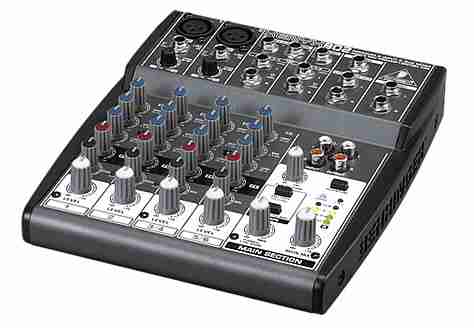
If you have a duplex soundcard and a mic all you need is a mic pre-amp with phantom power. A low cost option for this is to use something like the Behringer Xenyx 802 mixer. And no the cheaper Xenyx 502 can't be used because it doesn't have phantom power.
A great little compact preamp with phantom power is the $60 Rolls MP13 Mini-Mic Preamp.

When used with a PC software program and duplex soundcard, and an appropriate measurement microphone, this is an accurate and inexpensive measurement setup.
__________________________________________________________________________________________________________________________________________________________________
Measurement Microphones
Those people wanting a more accurate measuring system than that provided by the RS SPL meter, should consider the Behringer ECM-8000 mic. This is the stock microphone shipped with the very $pendy DEQX equalization system.

Note: it appears that the Nady CM100 mic is the same as the ECM-8000. Even the packaging and accessories are identical to the Behringer.

____________________________________________________________________________________________________________________________________________________________________________
Phantom Power Supply
If you already have a mic preamp and just need a phantom power supply for the microphone,
MCM has a nice little 48VDC supply

___________________________________________________________________________________________________________________________________________________________________________________
PC based loudspeaker testing software
Below are several low cost or freeware software programs for your consideration.
________________________________________________________________________________________________________________________________________________________________________________________
The current low buck champion and Swiss Army knife of these programs is Audio Tester. While not as polished as the other programs, it's quite functional.
It has a function generator

Does Waterfall plots
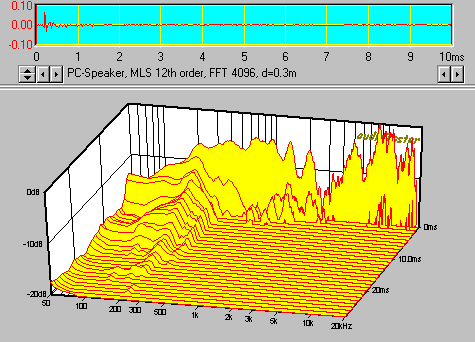
Contains an oscilloscope function

Can be used to measure T/S parameters,

and only costs ~$40USD.
____________________________________________________________________________________________________________________________________________________________________
TrueRTA is a moderately priced, easy to use program

It of course uses pink noise to measure in real-time, therefore it can't distinguish the output from the sub from the acoustical influence from the room. A feature added to the newer versions is the "Quick Sweep" function, that helps eliminate some room interactions. Included with TrueRTA are .cal files for both the RS meter and the Behringer ECM8000.
Here is a LINK to a "TrueRTA for Dummies" thread on AVS forum.
_________________________________________________________________________________________________________________________________________________________________________
ETF 5.0 /RPlusD Modal analyzer, is a true MLS (maximum length sequence) program

Therefore it can isolate the output of the speaker from the acoustical influence of the room. ETF is much more complicated to operate compared to TrueRTA. To assist with understanding and operating ETF, Tag-McLaren created a 33 page Room EQ case study using ETF 5.0. Here's a LINK to a .pdf of that study.
There is also extensive support and a user demo available on the ETF website. And program's author will even provide free tech support via toll-free number to people trying out the demo version of the program.
______________________________________________________________________________________________________________________________________________________________________________
Room EQ Wizard Freeware
John Mulcahy who helped create the Tag-McLaren Room EQ case study, has a nifty little freeware Java script program for EQing rooms.
One can import measurements taken with ETF into Room EQ Wizard. Here's a LINK explaining how to do that.

Room EQ Wizard requires the free Java Runtime Environment.
NOTE: Room EQ Wizard has the ability to utilize calibration files. If you're using the RS meter download the .cal file HERE. If you're using the Behringer ECM8000 mic download the .cal file HERE.
______________________________________________________________________________________________________________________________________________________________________________
SynRTA Freeware
This is a neat little freeware package from the makers of Praxis

This program uses quite a bit of CPU power, so it's best to start off with 1/24th octave measurements.
______________________________________________________________________________________________________________________________________________________________________
Click HERE to go to page 5
LINK back to the main FAQ page
LINK back to the forum